 By Diego Reyes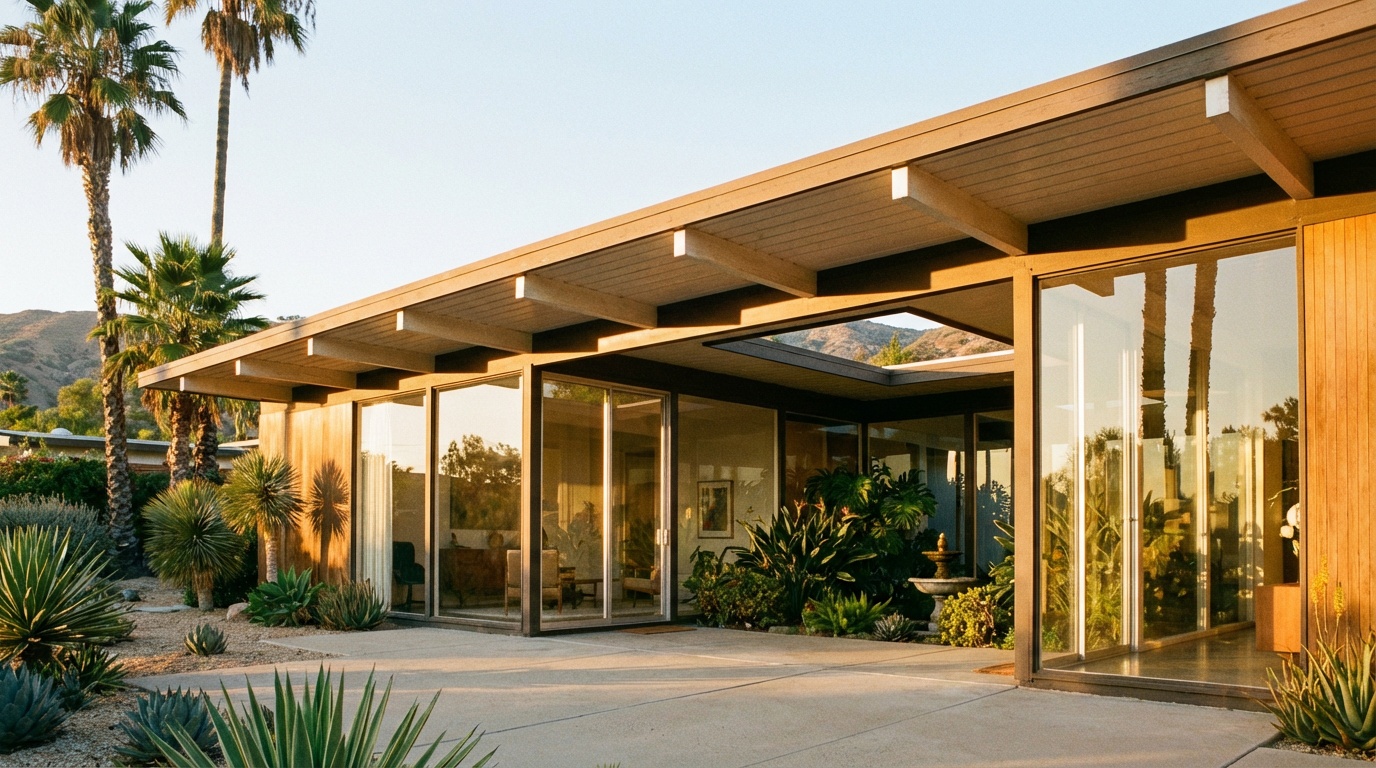
Iconic Mid-Century Modern Home Tours: The Legacy of Eichler and Neutra
Reading time: 14 minutes
Ever walked through a home and felt like time had folded back on itself—where the walls of glass dissolve the boundary between your living room and the garden, where exposed beams tell a story of postwar optimism, and where every line feels like a quiet manifesto about how life should be lived? That’s the Eichler and Neutra effect. And in 2026, it’s more powerful than ever.
Mid-century modern architecture isn’t just a design trend cycling back into vogue. It’s a philosophical blueprint for modern living that two visionary Californians—developer Joseph Eichler and architect Richard Neutra—helped codify into neighborhoods, communities, and individual homes that still command premium prices, deep devotion, and architectural pilgrimages from around the world.
Whether you’re a homebuyer considering a mid-century purchase, a design enthusiast planning a self-guided tour of California’s architectural heritage, or simply someone curious about why these homes matter so profoundly, this guide will walk you through the legacy, the living experience, and the lessons that Eichler and Neutra left behind.
Table of Contents
- Who Were Eichler and Neutra? The Visionaries Behind the Vision
- Defining Features: What Makes These Homes Unmistakable
- Home Tour Experiences: Where to Go in 2026
- Case Studies: Three Iconic Properties Up Close
- Market Reality: What These Homes Are Worth Today
- The Real Challenges of Owning a Mid-Century Icon
- Eichler vs. Neutra: A Comparative Look
- Buyer Interest by Architectural Era: 2026 Data
- Frequently Asked Questions
- Your Mid-Century Roadmap: Next Steps for Enthusiasts and Buyers
Who Were Eichler and Neutra? The Visionaries Behind the Vision
To understand why these homes inspire near-religious devotion, you need to understand the people who created them—and the historical moment that made their work possible.
Joseph Eichler: The Democratic Modernist
Joseph Eichler wasn’t an architect. He was a San Francisco Bay Area developer who, after renting a Frank Lloyd Wright–designed home in the 1940s, became fundamentally transformed by the experience of living in a space where architecture served human joy rather than social convention. His response was to build over 11,000 homes across California between 1949 and 1974, primarily in the Bay Area and Southern California, with a singular mission: to make thoughtfully designed, modernist housing accessible to middle-class American families.
What made Eichler remarkable wasn’t just his design sensibility—it was his ethics. He famously refused to enforce racial covenants at a time when most California developers did. His communities were among the first in the state to be explicitly open to buyers of all races. In cities like Palo Alto, San Mateo, and Marin County, Eichler neighborhoods became quiet laboratories for a more equitable, design-forward version of the American Dream.
Richard Neutra: The Poet of the Pastoral-Modern
Richard Neutra arrived in the United States from Vienna in 1923, carrying with him the intellectual DNA of European modernism—the Bauhaus movement, the teachings of Adolf Loos, and a deep commitment to architecture as a form of psychological and social healing. Where Eichler democratized modernism by building at scale, Neutra refined it by crafting singular masterworks for individual clients.
Neutra’s approach was rooted in what he called biorealism—the idea that the built environment profoundly affects human health, mood, and behavior. His homes, primarily in Los Angeles and Palm Springs, were designed to blur the line between interior and exterior, to flood spaces with natural light, and to create what he described as a “visual relief” from the psychological pressures of modern urban life. Among his most celebrated works are the Kaufmann Desert House (1946), the Lovell Health House (1929), and the VDL Research House in Silver Lake, Los Angeles.
By 2026, Neutra’s legacy has reached a fascinating inflection point: his buildings are not just celebrated as architectural monuments, but are actively being studied by urban planners and wellness researchers who see in his biorealist principles a prescient answer to 21st-century questions about mental health and sustainable urban design.
Defining Features: What Makes These Homes Unmistakable
So what exactly are you looking at when you tour an Eichler or a Neutra? Both share the broad vocabulary of mid-century modernism, but each has a distinct dialect worth understanding before you visit.
The Eichler Signature Elements
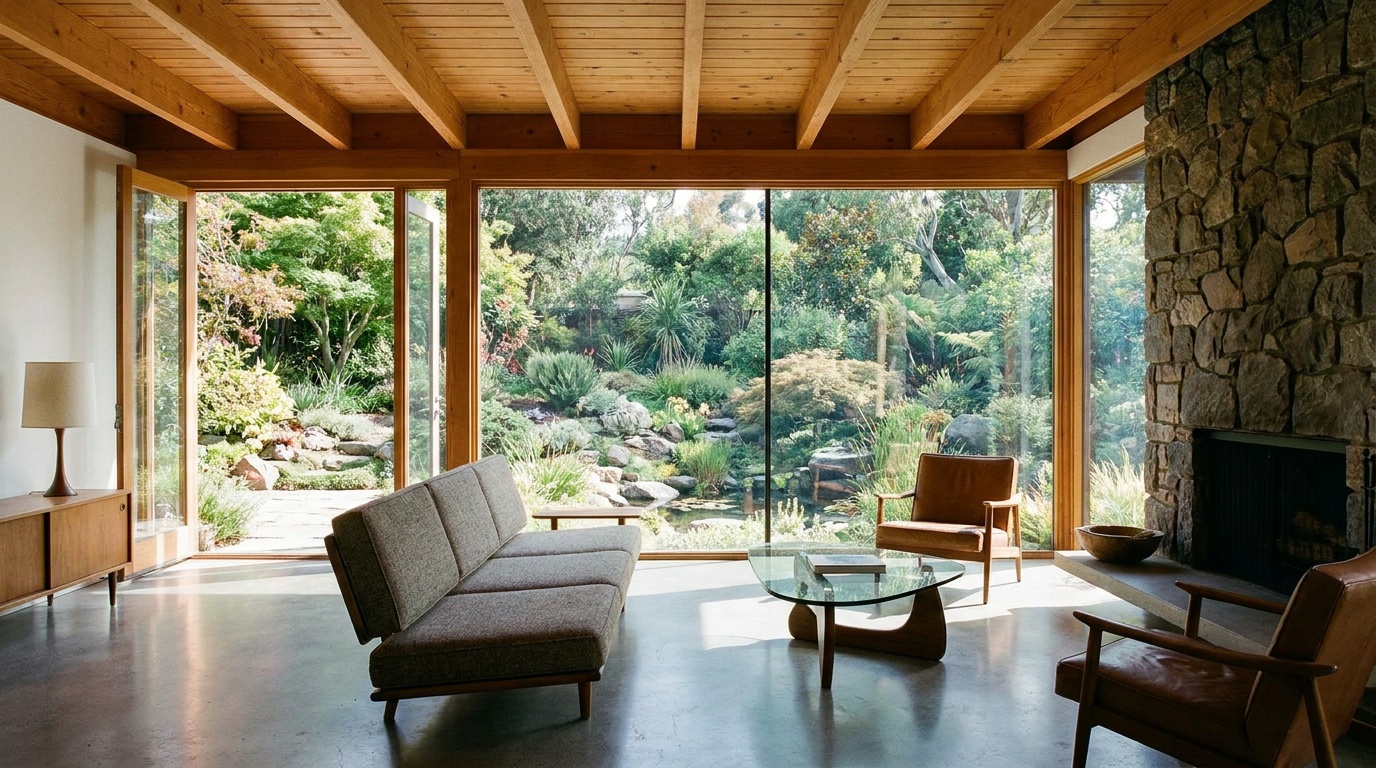
- Post-and-beam construction: Open wood-beam ceilings that eliminate the need for load-bearing interior walls, creating fluid, open floor plans.
- Atrium design: Many Eichlers feature a central open-air atrium—essentially a private outdoor room at the heart of the home that serves as a private garden, a light source, and a social hub.
- Floor-to-ceiling glass walls: Typically facing the private backyard, not the street—creating a paradox of radical openness within a protective shell.
- Radiant floor heating: Eichler was an early adopter of this technology, embedding hot-water pipes in concrete slab floors for warmth that rises naturally.
- Flat or low-pitched roofs: A clean, horizontal silhouette that emphasizes ground-level living over vertical grandeur.
- Simple, closed street facades: Privacy from the outside world, openness within. It’s a deliberate inversion of the typical suburban home.
The Neutra Signature Elements
- Steel-frame construction: Neutra pioneered the use of lightweight steel frames in residential architecture, enabling vast glass expanses and slender structural profiles.
- Integration with landscape: Neutra’s site planning was meticulous—homes were positioned to maximize views, capture prevailing breezes, and respond to the specific topography of each site.
- Continuous ribbon windows: Horizontal bands of glass that connect interior space visually to the surrounding landscape.
- Flat roofs with deep overhangs: Providing shade in California’s hot summers while framing views and protecting glass walls from direct sun.
- Natural material integration: Stone, wood, and water features were used not decoratively but structurally, as elements that mediated between architecture and nature.
- Custom built-in furniture: Neutra often designed the interior fixtures, cabinetry, and furniture as integral to the architecture—a holistic approach that treated every surface as part of a unified composition.
Home Tour Experiences: Where to Go in 2026
If you’ve caught the mid-century bug, good news: 2026 is a genuinely excellent year to explore these homes in person. A growing ecosystem of organized tours, preservation foundations, and even short-term rental opportunities has made access to these properties more democratic than at any point in the past two decades.
Bay Area Eichler Tours
The Eichler Network, the primary nonprofit dedicated to the preservation and celebration of Eichler homes, hosts its signature annual home tour in the spring, typically drawing 2,000–3,500 visitors to neighborhoods in San Mateo, Palo Alto, and Marin County. In 2025, the organization reported its highest-ever attendance—a reflection of surging interest among younger buyers drawn to both the aesthetic and the sustainability credentials of these homes.
Palo Alto’s Green Gables neighborhood and the Fairmeadow and Duveneck-St. Francis neighborhoods remain the most concentrated and best-preserved Eichler communities, where you can walk entire streets of atrium homes and get a genuine sense of Eichler’s original neighborhood vision. Self-guided walking tours are available through the Eichler Network’s app, updated for 2026 with augmented reality overlays that show original construction photographs alongside current views.
Los Angeles Neutra Pilgrimage
In Los Angeles, the Neutra VDL House in Silver Lake operates as a museum and research facility administered by Cal Poly Pomona, offering regular tours on Saturdays. Admission is $10, and the experience of walking through a home that Neutra literally designed as a live-work laboratory for his own research into architecture and human behavior is genuinely moving.
The Los Angeles Conservancy’s Modern Committee—known as LA Mod—runs an annual tour called Modernism in America that in 2026 features a curated selection of Neutra homes alongside works by his contemporaries, including Rudolph Schindler, Craig Ellwood, and Pierre Koenig. The 2026 edition focuses on Silver Lake and Los Feliz, two neighborhoods where the density of mid-century masterworks per square mile is almost startling.
Palm Springs: The Mid-Century Capital
No conversation about mid-century modern home tours is complete without Palm Springs. The city’s annual Modernism Week, held every February, has grown into one of the most significant architectural tourism events in North America, with the 2026 edition attracting an estimated 100,000 visitors over ten days. Tours include Neutra’s Kaufmann House, multiple Lautner properties, and a dedicated “Eichler in the Desert” tour of the lesser-known Eichler tracts in nearby Sunnyvale and San Jose that were designed for warmer climates.
Case Studies: Three Iconic Properties Up Close
Case Study 1: The Greenmeadow Eichler, Palo Alto
Built in 1955, this four-bedroom atrium model in Palo Alto’s Greenmeadow neighborhood has been owned by the same family for three generations. When the current owners—a couple who both work in sustainable architecture—took possession in 2019, they faced a common Eichler dilemma: how to modernize without destroying the integrity of the original design.
Their solution, completed in 2023, is now frequently cited as a model preservation-renovation. They replaced the original single-pane glass walls with custom-fabricated double-pane units that precisely matched the original frame profiles, upgraded the radiant floor system to a modern hydronic system compatible with their solar array, and restored the atrium’s original exposed aggregate concrete without resurfacing. The total renovation cost was approximately $380,000—and the home’s estimated value in 2026 is $2.8 million, roughly $600,000 above comparable non-Eichler properties in the same neighborhood.
Case Study 2: Neutra’s Tremaine House, Santa Barbara
Completed in 1948 for Warren and Katharine Tremaine, this house represents Neutra at his most confident. Set into a hillside above Santa Barbara, the home uses a series of terraced steel-and-glass pavilions that step down the slope, each offering framed views of the Pacific. The California Preservation Foundation listed it as one of the state’s ten most significant at-risk modern landmarks in 2024.
A 2025 acquisition by a preservation-minded family from San Francisco—who purchased it for $7.4 million—has brought renewed attention to the property. The new owners have committed to a multi-year restoration in partnership with the Neutra Institute for Survival Through Design, with guided tours planned to begin in late 2026. Architectural historians consider this one of the most significant preservation victories of the decade.
Case Study 3: The Rancho Bernardo Eichler Tract, San Diego
Less well-known than the Bay Area communities, the Rancho Bernardo Eichlers in San Diego represent Eichler’s Southern California ambitions. Built between 1963 and 1967, these 185 homes were among his last projects, and they reflect a slightly evolved design vocabulary—slightly steeper roof pitches and more enclosed street facades adapted for San Diego’s stronger sun.
In 2026, the Rancho Bernardo Eichler Homeowners Association reports that median home prices in the tract have risen approximately 22% since 2023, outperforming the surrounding San Diego market by roughly 8 percentage points. This reflects a broader national pattern: mid-century modern homes consistently outperform their neighborhoods when buyers are educated about architectural significance.
Market Reality: What These Homes Are Worth Today
Let’s talk numbers, because the market story for Eichler and Neutra properties in 2026 is genuinely fascinating—and occasionally surprising.
According to data compiled by Compass Real Estate’s Architectural Homes Division in early 2026, verified Eichler homes in Bay Area neighborhoods command an average 18–25% premium over comparable non-Eichler properties. Neutra-designed homes, as individual architectural masterworks, command even more dramatic premiums—with notable sales in 2025 including a restored Neutra property in Bel Air that sold for $12.3 million, setting a new benchmark for mid-century residential sales in Los Angeles County.
The driver isn’t purely aesthetic nostalgia. Several converging factors explain the sustained market strength:
- Sustainability alignment: The open-plan, naturally ventilated, radiant-heated design of Eichler homes aligns well with modern energy efficiency priorities—with appropriate upgrades, many achieve strong green building scores.
- Scarcity: No new Eichler homes will ever be built, creating genuine supply constraints that support long-term value.
- Community identity: Eichler neighborhoods have unusually strong homeowner associations and community cultures, making them desirable for buyers seeking social connection alongside design quality.
- Cultural cachet: Media coverage, social media visibility, and the growing prestige of architectural tourism have elevated these homes’ profiles significantly among younger buyers.
The Real Challenges of Owning a Mid-Century Icon
Here’s the straight talk: owning an Eichler or a Neutra property isn’t for the faint of heart—or the thin of wallet. These homes are magnificent, but they come with specific, well-documented challenges that prospective buyers must understand clearly before falling in love.
Challenge 1: The Maintenance Reality of Aging Systems
Those beautiful radiant floor heating systems that Eichler pioneered? Many of the original copper piping installations are now 60–70 years old, and leaks within the concrete slab are both common and expensive to address. Remediation typically costs between $15,000 and $40,000, depending on the severity, and can involve partial demolition of flooring. Pro Tip: Before purchasing any Eichler home, commission a specialized thermal imaging inspection that can identify radiant system leaks without destructive investigation.
Similarly, Neutra’s extensive glass walls—while visually spectacular—present ongoing challenges around weatherproofing, thermal performance, and seal integrity. The original single-pane systems are thermally inefficient by modern standards, and replacement requires custom fabrication to preserve architectural integrity.
Challenge 2: Preservation vs. Modernization Tensions
Many Eichler homes exist within informal preservation frameworks—neighborhood covenants, HOA guidelines, or local landmark designations—that restrict modifications. Even without formal protections, community pressure within Eichler neighborhoods can be intense. The community’s strong identity is one of its greatest assets, but it can also feel constraining to buyers who want to make significant changes.
The smartest approach is to treat these constraints not as obstacles but as guardrails. The market consistently validates preservation: homes that have been sensitively restored command stronger prices than those that have been heavily modified, even when the modifications are technically superior in terms of performance.
Challenge 3: Finding Qualified Craftspeople and Contractors
Working on a mid-century modern home requires contractors who understand the specific detailing of post-and-beam construction, steel frame systems, and the material palette of the era. In 2026, the Society of Architectural Historians and the National Trust for Historic Preservation both maintain referral networks for qualified mid-century restoration specialists—but demand significantly exceeds supply in most California markets. Expect longer lead times and premium pricing for skilled work.
Eichler vs. Neutra: A Comparative Look
| Metric | Eichler Homes | Neutra Homes |
|---|---|---|
| Scale of Production | ~11,000 homes built (1949–1974) | ~300–400 residential commissions |
| Primary Market (2026) | $1.2M–$3.5M (Bay Area) | $3M–$15M+ (LA/Palm Springs) |
| Construction System | Post-and-beam wood frame | Steel frame, custom concrete |
| Accessibility | Designed for middle-class buyers | Designed for affluent clients |
| Tour/Visit Accessibility (2026) | Annual neighborhood tours, app-guided walks | Museum homes, curated architectural tours |
Buyer Interest by Architectural Era: 2026 Search Trend Data
The following visualization reflects 2026 buyer search interest data compiled from Compass Real Estate and Zillow’s Architectural Homes category, indexed to show relative search volume by era among buyers in California, Arizona, and Florida—the three states with the most significant mid-century modern housing stock.
Relative Buyer Search Interest by Architectural Era (2026, Indexed to 100)
Source: Compass Architectural Homes Division & Zillow search analytics, Q1 2026. Values indexed relative to highest-interest category.
Frequently Asked Questions
Are Eichler homes a good investment in 2026?
Yes, with important qualifications. Eichler homes in well-maintained Bay Area tracts have consistently outperformed broader market benchmarks over the past decade, and the premium for architectural significance shows no sign of diminishing—particularly as the scarcity narrative strengthens and buyer demographics shift toward younger, design-educated purchasers. However, the investment case depends heavily on condition: a poorly maintained Eichler with deferred radiant system repairs and compromised glazing can easily consume the premium you paid in restoration costs. Due diligence—including thermal imaging, specialist inspections, and a realistic renovation budget—is absolutely essential. When approached strategically, an Eichler in a landmark-quality neighborhood is one of the most defensible residential investments in California real estate.
Can I visit Neutra-designed homes without owning one?
Absolutely—and 2026 offers more access than ever. The Neutra VDL House in Silver Lake, Los Angeles, hosts regular Saturday tours administered by Cal Poly Pomona. LA Mod’s annual Modern architecture tours include verified Neutra properties on their itineraries. Modernism Week in Palm Springs (February annually) provides curated access to the Kaufmann Desert House and other Neutra properties in the Coachella Valley. Additionally, several Neutra-designed properties are available as short-term vacation rentals through platforms like Airbnb and VRBO—staying overnight in a Neutra home is genuinely a different, richer experience than a 45-minute docent tour, and it remains surprisingly affordable compared to what you might expect, with rates typically ranging from $500 to $1,200 per night.
What should I look for when touring a mid-century modern home to assess its preservation integrity?
Focus on four key areas. First, examine the roofline and overhangs—flat or gently pitched roofs with deep overhangs are structural signatures; patched or replaced sections with different material profiles indicate prior damage or poor repair. Second, check the glazing systems: original single-pane steel- or wood-framed windows have a specific profile depth and detail that is difficult to replicate cheaply. Replacement windows with chunky vinyl frames are a significant authenticity compromise. Third, look at interior ceiling planes—exposed post-and-beam ceilings should be intact; dropped ceilings or spray foam applications are warning signs. Finally, investigate the mechanical systems: ask specifically about the radiant floor heating status and whether a thermal imaging inspection has been conducted recently. These four areas tell you almost everything you need to know about the integrity and maintenance history of a mid-century property.
Your Mid-Century Roadmap: Turning Appreciation Into Action
Here’s where we bring it home—because understanding the legacy of Eichler and Neutra is the first step, but knowing what to do with that understanding is what actually transforms appreciation into experience, investment, or preservation advocacy.
Your next steps, wherever you are on the journey:
- Plan a tour this year. Whether it’s the Eichler Network’s spring home tour in Palo Alto, a Saturday afternoon at the Neutra VDL House, or a February pilgrimage to Palm Springs for Modernism Week, commit to experiencing these homes in person. No photograph captures the spatial experience of an atrium Eichler or a Neutra glass pavilion. Book early—2026 demand for these events is at record levels.
- Get educated before you buy. If you’re considering purchasing a mid-century modern property, connect with a realtor who specializes in architectural homes (Compass, Sotheby’s, and Hilton & Hyland all have dedicated divisions in California). Request a specialist inspection using thermal imaging before making any offer.
- Support preservation organizations. The Eichler Network, the Neutra Institute, the Los Angeles Conservancy, and the California Preservation Foundation all do critical work protecting these homes from unsympathetic modification and demolition. Membership starts at $35–$75 annually and typically includes access to private tours unavailable to the general public.
- Document your visits. The mid-century modern community thrives on shared documentation. Platforms like Dwell, ArchDaily, and dedicated Instagram communities have become important preservation tools—photographs and firsthand accounts build public awareness that translates directly into political and financial support for preservation efforts.
- Consider the broader implications. In an era of rapid urban change, climate anxiety, and housing affordability crises, the principles that Eichler and Neutra championed—democratic access to good design, harmony between built and natural environments, homes that serve human psychological wellbeing—are not historical curiosities. They are urgent, actionable principles. The best tribute to these architects is to carry their ideas forward into the next generation of building.
“The house should be the treasure chest of living.” — Le Corbusier, whose work directly influenced both Eichler and Neutra, and whose challenge remains unanswered by most of what we build today.
Mid-century modern architecture’s resurgence in 2026 isn’t nostalgia—it’s recognition. In Eichler’s atrium homes and Neutra’s glass pavilions, a generation of postwar builders answered the question of how architecture could serve human flourishing rather than merely shelter it. The fact that we’re still touring, studying, preserving, and paying premiums for these homes seven decades later suggests they got something profoundly right.
The question worth sitting with: If you could live in a home designed with the clarity of purpose and commitment to human wellbeing that Eichler and Neutra brought to theirs, what would you need to change—about what you’re looking for, where you’re looking, or what you’re willing to invest?
The answer might just reframe your entire relationship with where—and how—you live.
Article reviewed by Rachel Wu, Budget Control & Project Timeline Management Consultant, on May 4, 2026