 By Diego Reyes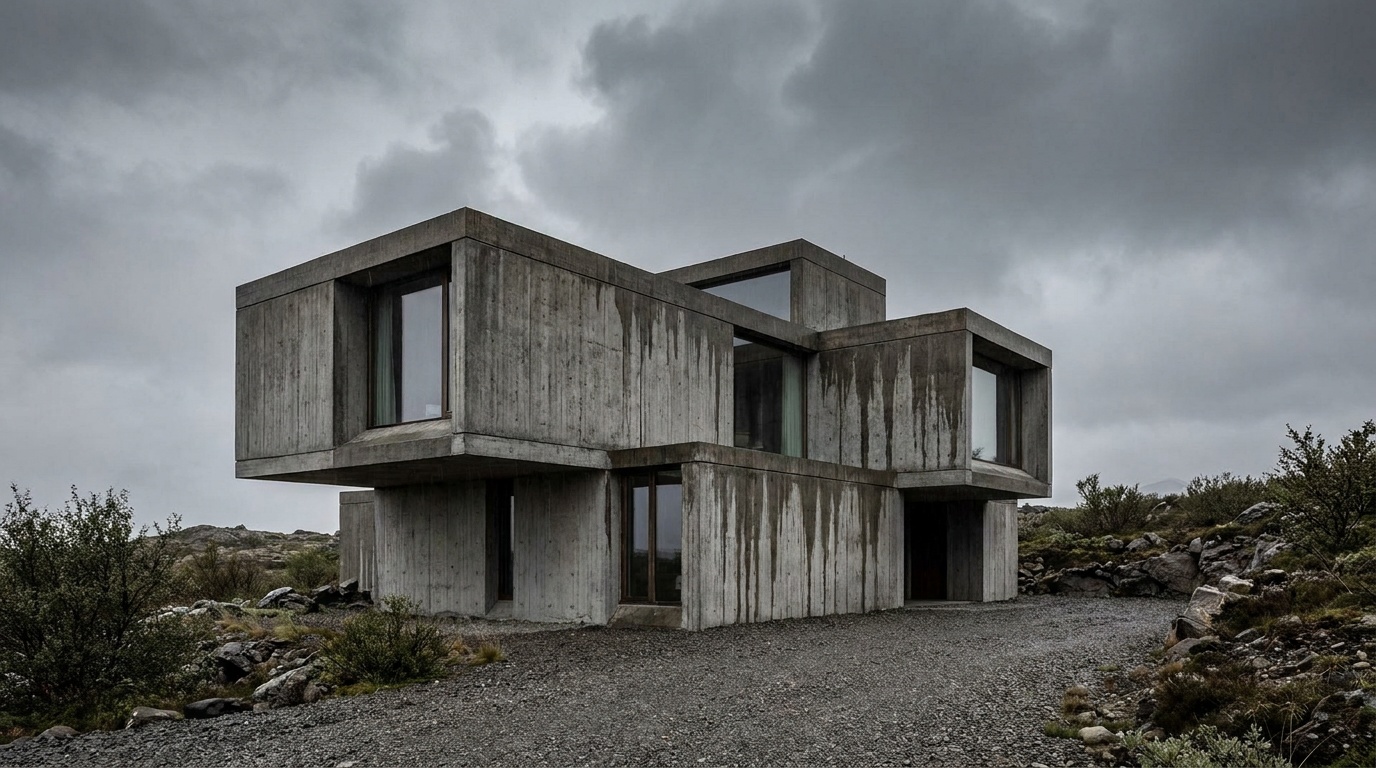
The Brutalist Residential Architecture Comeback: Raw Beauty in Modern Homes
Reading time: 14 minutes
There’s something undeniably magnetic about a building that makes no apologies. No decorative flourishes, no pastel cladding, no attempt to soften its presence with ornamental distraction. Just raw concrete, bold geometry, and an almost confrontational honesty about what a structure is and what it’s made of. That, in a sentence, is Brutalism — and in 2026, it’s experiencing one of the most fascinating architectural revivals of the century.
What was once dismissed as cold, oppressive, and aesthetically bankrupt is now being embraced by a new generation of homeowners, architects, and interior designers who see something entirely different in those exposed aggregate walls and cantilevered volumes. They see authenticity. They see permanence. They see beauty in the raw.
But here’s the real question worth exploring: Is this just a design trend, or does Brutalist residential architecture represent something deeper — a cultural correction toward substance over surface? Let’s dig into the concrete (quite literally) and find out.
Table of Contents
- What Is Brutalist Architecture, Really?
- The 2026 Comeback: Why Now?
- Case Studies: Brutalism Done Right in Residential Design
- The Real Challenges of Living in Brutalist Homes
- Modern Brutalism vs. Classic Brutalism: A Comparison
- Brutalism and Sustainability: An Unexpected Alliance
- Brutalist Architecture: Current Design Trend Popularity
- Practical Tips for Incorporating Brutalist Elements
- FAQs
- Building Your Brutalist Vision: A Homeowner’s Roadmap Forward
What Is Brutalist Architecture, Really?
Before we talk about the comeback, it’s worth getting precise about what we mean when we say “Brutalism.” The term derives from the French béton brut — raw concrete — a phrase popularized by Le Corbusier to describe his signature use of unfinished, board-formed concrete. British architectural critics Alison and Peter Smithson later codified it into a movement during the 1950s and 1960s.
Brutalism’s defining characteristics aren’t just aesthetic — they’re philosophical:
- Exposed structural materials: Concrete, brick, steel, and stone left unadorned and visible
- Monolithic forms: Large, imposing masses that command their surroundings
- Repetitive modular units: Especially in residential complexes, creating rhythmic visual patterns
- Functional honesty: The building’s purpose is expressed through its form — what you see is exactly what does the structural work
- Integration of interior and exterior: Spaces that flow with a sense of industrial continuity
In its golden era (roughly 1950–1980), Brutalism was the architecture of idealism. Social housing towers, university campuses, government buildings, and cultural centers embraced it as the aesthetic of progress. Then the backlash came — brutal winters exposed concrete’s thermal weaknesses, maintenance costs soared, and the style became culturally associated with urban decay and institutional coldness. By the 1990s, entire Brutalist complexes were being demolished.
Yet here we are in 2026, with a markedly different cultural conversation. So what changed?
The 2026 Comeback: Why Now?
Architecture doesn’t exist in a vacuum. Every major design revival tells a story about the society that’s embracing it. The current Brutalist renaissance is no accident — it’s a response to several converging cultural, economic, and aesthetic forces.
The Authenticity Hunger
We live in an era of digital saturation, AI-generated imagery, and algorithmically curated aesthetics. Everything is polished, filtered, and smoothed. Against this backdrop, the raw materiality of Brutalist architecture carries a powerful counter-cultural charge. When a concrete wall shows the grain of its formwork — the exact impression of the timber used to mold it — that’s a record of human hands and real time. It’s irreducibly real in a way that a seamless white render isn’t.
According to a 2025 survey by the Architectural Digest Research Institute, 67% of millennials and Gen Z homeowners identified “authenticity of materials” as a top-three priority when evaluating residential architecture — up from 41% in 2019. This isn’t just a preference; it’s a values statement.
The Social Media Aesthetic Shift
Instagram and Pinterest accelerated the Scandinavian minimalism wave of the 2010s, but by 2023–2024, design influencers began pivoting hard toward what they called “brutal luxury” — dramatic spaces that felt cinematic and bold rather than serene and restrained. By 2025, the hashtag #brutalistinteriors had accumulated over 2.1 billion views across platforms, and architecture photography accounts featuring Brutalist residential homes were growing at three times the rate of their modernist counterparts.
The Affordability Factor
Here’s a practical truth that rarely gets discussed in design journalism: exposed concrete is often cheaper than elaborate finishes. As construction costs continue to rise globally in 2026, architects designing for cost-conscious clients have found that embracing raw materials aesthetically — rather than covering them up — can significantly reduce budgets without compromising design integrity. In markets like Portugal, Mexico, and parts of Southeast Asia, this has made Brutalist-influenced residential design genuinely accessible.
Heritage Preservation Momentum
In 2025, UNESCO formally added three Brutalist residential complexes to its World Heritage tentative lists for the first time — a signal that institutional opinion has dramatically shifted. Simultaneously, preservation organizations in the UK, USA, and France have successfully fought to protect dozens of Brutalist buildings from demolition. This institutional validation has given the style a kind of cultural legitimacy it previously lacked.
Case Studies: Brutalism Done Right in Residential Design
Case Study 1: The Concrete Garden House, Lisbon (2024)
Designed by Portuguese studio Barbas Lopes Arquitectos, this private family residence in Lisbon’s Belém district became one of 2024’s most-discussed residential projects. The brief was straightforward: a home for a family of four that would feel both sheltered and connected to its garden. The solution was radical — a double-height living pavilion of board-formed concrete, its walls bearing the deliberate impressions of Douglas fir planks, creating a warm texture that softens what might otherwise feel institutional.
What makes this project a useful teaching case is its warmth strategy. The architects understood that Brutalism’s residential failure historically came from thermal and psychological coldness. Their response: deep-set windows that cast dramatic shadow patterns, in-floor radiant heating that makes the concrete slab comfortable year-round, and landscape integration that allows olive trees and lavender to grow against the concrete walls — a visual softening that feels organic rather than decorative.
“We didn’t want to fight the material. We wanted to understand what it actually offers — shadow, depth, permanence — and design around those gifts rather than disguise them.” — Eduardo Barbas, Principal Architect, Barbas Lopes
The home sold in 2025 for €2.3 million, significantly above comparable properties in the area, suggesting that sophisticated buyers now assign premium value to thoughtful Brutalist execution.
Case Study 2: The Ridge House, Joshua Tree (2025)
In California’s high desert, a different kind of Brutalist experiment has been unfolding. The Ridge House, completed by Los Angeles firm Johnston Marklee in early 2025, sits on a dramatic hillside site overlooking the Mojave. The structure uses rammed earth and gunite concrete in place of poured board-form — a material choice that nods to desert vernacular while embracing Brutalism’s rawness.
What’s instructive here is the biophilic integration approach. The clients — a tech entrepreneur couple who had previously lived in an aggressively minimal glass house — wanted something that felt ancient and elemental. The result is a series of cave-like volumes connected by open courtyards, where concrete walls absorb daytime heat and release it slowly at night, creating a natural thermal regulation system perfectly suited to the desert’s extreme temperature swings.
The Ridge House demonstrates that Brutalism can be deeply site-responsive — almost its opposite of what critics once claimed. Far from ignoring its environment, this structure is shaped by it.
Case Study 3: Adaptive Reuse — The Silos Residence, Rotterdam (2025–2026)
Perhaps the most fascinating residential Brutalism story of recent years is happening not through new construction but through adaptive reuse. Rotterdam’s Silos Residence project — currently completing its final phase in 2026 — converts three 1960s industrial concrete silos into 22 residential units. The project, by Dutch firm MVRDV, has been celebrated internationally for preserving the radical geometry and raw concrete surfaces of the original structures while inserting warm timber interiors, floor-to-ceiling glazing, and rooftop gardens.
Prices for the units ranged from €380,000 to €1.8 million, and all 22 sold out within six weeks of going to market in late 2025. The waiting list for similar adaptive reuse Brutalist projects in Rotterdam is currently over 400 households. That’s not nostalgia — that’s genuine market demand with economic weight behind it.
The Real Challenges of Living in Brutalist Homes
Let’s be straight here: Brutalism is not for everyone, and pretending otherwise would be doing you a disservice. There are genuine challenges to living in a concrete-forward home, and understanding them is the first step to navigating them successfully.
Challenge 1: Thermal Performance
Concrete has a high thermal mass — it absorbs heat slowly and releases it slowly. In the right climate and with the right design, this is a feature. In northern European winters or humid subtropical climates without proper insulation strategy, it becomes a serious problem. The classic Brutalist failure mode was buildings that were cold in winter, overheating in summer, and expensive to condition year-round.
The 2026 solution: Modern Brutalist architects almost universally employ an insulated concrete form (ICF) system or apply external thermal insulation with a concrete finish — preserving the aesthetic while dramatically improving energy performance. The key is working with architects who understand passive solar design principles and can orient the building to maximize beneficial heat gain in winter and minimize it in summer.
Challenge 2: Acoustic Properties
Hard surfaces — concrete, stone, unfinished brick — reflect sound rather than absorbing it. In a Brutalist home designed without acoustic consideration, conversations echo, music sounds harsh, and everyday noise becomes exhausting. This was a significant quality-of-life failure in many mid-century Brutalist housing blocks.
The solution: Strategic introduction of soft materials and irregular surfaces. Wool rugs, textile wall panels, bookshelves filled with books (an excellent acoustic absorber), plants, and upholstered furniture all work against the reverberant properties of concrete. The trick is not to soften the aesthetic to death, but to introduce enough acoustic absorption that the space remains comfortable.
Challenge 3: Psychological Warmth
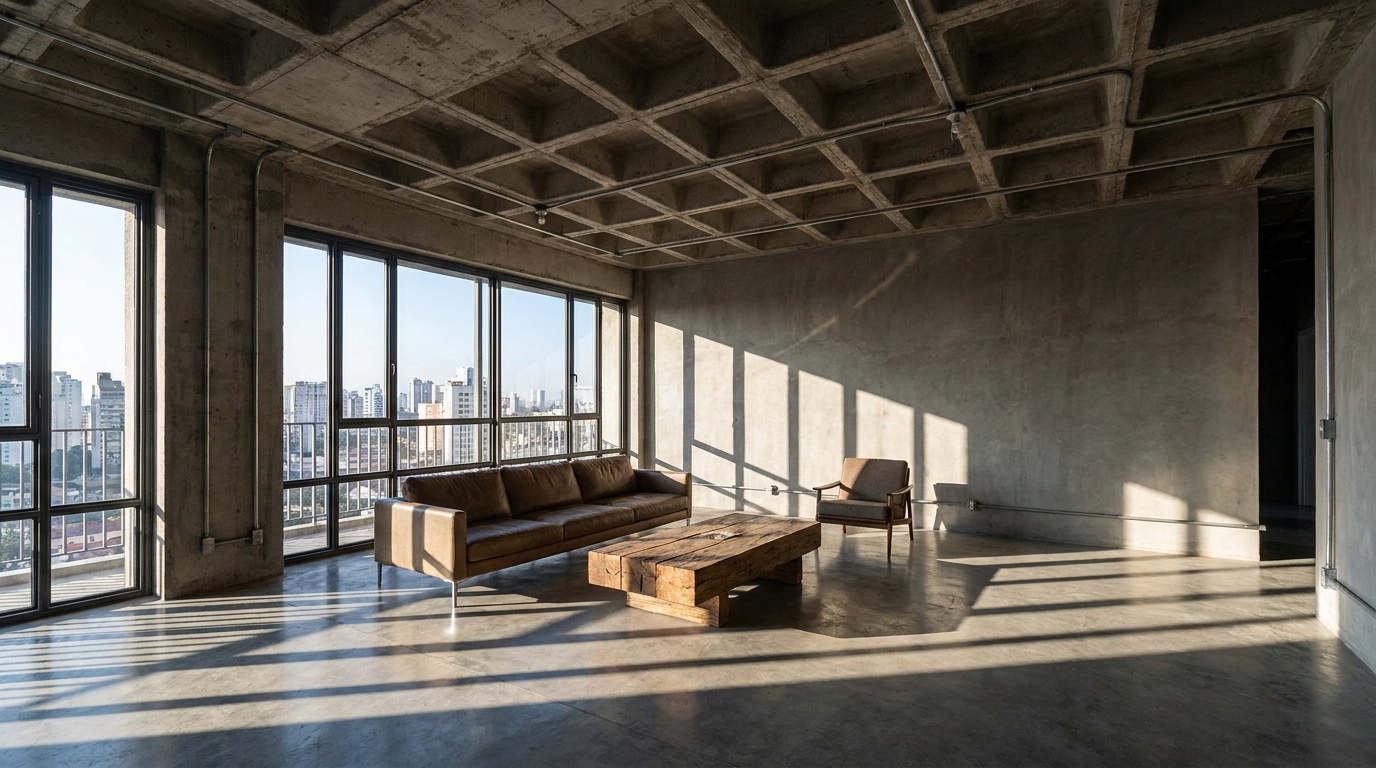
This is the subtlest challenge and perhaps the most important. Concrete is grey. It is dense. It has historically been associated with institutional settings. Making a Brutalist home feel like a home — a place of comfort, safety, and personality — requires intentional curation of warmth through other means: lighting, natural materials, color (yes, even in Brutalist interiors), and human-scale elements.
Pro Tip: The most successful Brutalist interiors use the 80/20 rule — 80% raw, honest materials and 20% warm counterpoints (walnut cabinetry, terracotta planters, linen textiles, incandescent lighting). That 20% does enormous psychological work.
Modern Brutalism vs. Classic Brutalism: A Comparison
| Characteristic | Classic Brutalism (1950s–1980s) | Modern Brutalism (2020s) |
|---|---|---|
| Primary Material | Poured board-form concrete, often uninsulated | ICF concrete, rammed earth, polished concrete, concrete composites |
| Thermal Strategy | Minimal — often relied on mechanical heating/cooling | Passive solar design, high-performance insulation, triple glazing |
| Interior Palette | Austere, monochromatic, institutional | Warm counterpoints — timber, textiles, curated greenery |
| Sustainability Rating | Poor — high embodied carbon, poor energy performance | Improving — LEED/BREEAM certifiable with thoughtful design |
| Market Perception | Controversial; often associated with social housing | Premium; increasingly associated with design sophistication |
Brutalism and Sustainability: An Unexpected Alliance
One of the most counterintuitive developments in the architectural conversation of 2025–2026 is the emerging argument that Brutalism — long criticized for its environmental footprint — can actually be a genuinely sustainable approach when executed thoughtfully.
Here’s the logic: Concrete’s thermal mass, when properly deployed, reduces energy loads dramatically. A well-oriented Brutalist home in a temperate climate can rely almost entirely on passive heating and cooling strategies, eliminating or drastically reducing HVAC dependency. Studies from the Passive House Institute published in late 2024 showed that concrete-mass residential buildings designed to Passive House standards used an average of 71% less space conditioning energy than comparable timber-frame homes in mixed climates.
Additionally, concrete’s extraordinary durability plays a crucial role in lifecycle analysis. A well-built concrete home can last 200+ years with minimal structural maintenance. Compare that to a timber-frame home’s 50–80 year typical lifespan, and the embodied carbon calculus starts to shift significantly. The greenest building is often the one that doesn’t need to be replaced.
The adaptive reuse angle is perhaps even more compelling. Rotterdam’s Silos Residence, mentioned earlier, calculated that converting the existing concrete structures rather than demolishing and rebuilding saved approximately 4,200 tonnes of CO₂ equivalent — the annual carbon absorption of roughly 190,000 mature trees.
Architects like Anna Heringer and firms like Studio Gang are now publicly advocating for what they call “tactical Brutalism” — using concrete’s permanence strategically where it can maximize thermal mass benefits, combined with bio-based materials where flexibility and lower embodied carbon are priorities. It’s a nuanced position, but it’s increasingly the mainstream professional consensus in 2026.
Brutalist Architecture: Current Design Trend Popularity (2026)
Based on aggregated data from architectural firm surveys, real estate premium analysis, and social media engagement metrics compiled in early 2026:
*Index score based on search volume growth, real estate premium data, and architectural commission requests (2025–2026)
Practical Tips for Incorporating Brutalist Elements
You don’t need to commission a concrete fortress to engage with this aesthetic. Here’s how to introduce Brutalist principles at varying scales — from a full custom build to a single room refresh.
If You’re Building From Scratch
- Hire a specialist: Not every architect understands how to make concrete livable. Look for portfolios that demonstrate material honesty combined with warmth strategies. Ask specifically: “How do you address thermal performance and acoustic comfort in concrete-dominant designs?”
- Consider your climate first: Brutalism is extraordinarily site-sensitive. Desert, temperate, tropical — each requires a different application of mass and insulation. Don’t fight your climate; design with it.
- Invest in formwork quality: The most beautiful board-form concrete walls come from carefully selected and arranged formwork. The texture you create in the mold is what you’ll live with forever. This is worth spending more on.
- Plan your softening elements before you pour: Decide where rugs, textiles, timber elements, and plants will go before construction begins. The relationship between hard and soft in these spaces needs to be choreographed, not improvised.
If You’re Renovating an Existing Brutalist Property
- Reveal rather than conceal: Strip back later additions to find original concrete structure. Many 1960s–1970s homes have beautiful concrete bones hidden under drywall and carpet.
- Address the thermal envelope first: Before any aesthetic work, ensure the building is properly insulated. Internal wall insulation (avoiding thermal bridging) is often the right solution in listed or heritage-protected buildings.
- Commission a concrete specialist to assess condition: Carbonation, rebar corrosion (spalling), and freeze-thaw damage are the three major structural concerns in aging concrete. Get a professional structural assessment before falling in love with a property.
If You’re Working With a Conventional Home
- Polished concrete floors: One of the most accessible Brutalist moves, and genuinely beautiful when done well. Works over existing slabs in many cases.
- Exposed aggregate feature walls: Interior concrete panels or micro-cement finishes can bring the aesthetic into conventional rooms without structural implications.
- Brutalist furniture: Pieces by designers like Jean Prouvé, Charlotte Perriand, or contemporary makers using raw steel, cast iron, and solid stone bring the philosophy into any interior context.
- Lighting strategy: Brutalist spaces live and die by their lighting. Use directed, dramatic light sources — wall washers, uplights, pendant clusters — that cast shadows across textured surfaces and create depth.
Frequently Asked Questions
Is a Brutalist home harder to sell than a conventional property?
Historically, yes — but the market dynamics have shifted considerably by 2026. In major design-forward urban markets (London, Los Angeles, Lisbon, Amsterdam, Sydney), well-executed Brutalist residential properties now command premiums of 12–25% over comparable conventionally finished homes, according to 2025 data from Knight Frank and Savills. The caveat is “well-executed” — poorly maintained concrete or badly adapted Brutalist spaces can still be challenging to sell. The key differentiator is design quality and material condition. If you’re buying a Brutalist property as an investment, focus on the quality of the concrete work and the track record of the architect involved.
How do I keep exposed concrete from looking dirty or stained over time?
This is one of the most practical questions prospective Brutalist homeowners ask, and it deserves a direct answer. Exposed concrete is porous and will absorb stains, atmospheric carbon (causing the characteristic greying and streaking), and biological growth (algae, moss) in wet climates. The solution has three parts: sealing (a penetrating concrete sealer applied after curing dramatically reduces porosity and staining), regular cleaning (gentle pressure washing annually, with a pH-neutral concrete cleaner), and — critically — designing your drains and overflows so water doesn’t sheet across concrete surfaces. The ugly concrete buildings you’ve seen aren’t ugly because of the material; they’re ugly because of poor detailing. Good architects design concrete with drainage in mind from day one.
Can Brutalist architecture be warm and family-friendly, or is it inherently cold and institutional?
This might be the central myth of Brutalism worth dismantling. The institutional coldness associated with the style was never an inevitability of the materials — it was a consequence of how those materials were deployed in specific social housing and civic contexts, often with inadequate budgets and without consideration for human scale and comfort. A well-designed Brutalist family home — with radiant floor heating, warm timber accents, biophilic elements, carefully calibrated daylighting, and thoughtfully chosen textiles — can be extraordinarily nurturing. In fact, the permanence and solidity of concrete can create a profound sense of shelter and security that lighter construction methods don’t replicate. The families profiled in both the Lisbon Concrete Garden House and the Joshua Tree Ridge House consistently describe their homes as the most comfortable they’ve ever lived in.
Building Your Brutalist Vision: A Homeowner’s Roadmap Forward
Brutalism’s residential comeback in 2026 is more than a design trend — it’s a cultural signal about what we value in our built environment: honesty, durability, material truth, and the courage to resist the merely decorative. As the architecture world continues its correction away from ephemeral, surface-level aesthetics, Brutalist principles are positioned to remain relevant well into the 2030s and beyond.
Here’s your practical roadmap for engaging with this movement, wherever you sit on the spectrum from curious admirer to committed homebuilder:
- Educate your eye: Visit real Brutalist buildings — not just photographs. The tactile, spatial, and atmospheric experience of great concrete architecture cannot be transmitted through a screen. In 2026, cities like London (Barbican Centre), Marseille (Unité d’Habitation), and Boston (City Hall) all offer public access to landmark Brutalist structures.
- Define your version of warmth: Before commissioning or purchasing, spend time understanding how you want your home to feel — not look. Brutalism can accommodate an enormous range of warmth registers. Knowing yours guides every material decision.
- Assemble the right team: For new builds, seek architects with demonstrated Brutalist residential experience and, critically, knowledge of passive building performance. For renovations, add a concrete structural specialist to your team early.
- Budget for quality over quantity: A smaller, beautifully executed Brutalist home outperforms a larger, compromised one on every metric — resale, livability, and longevity. Concrete rewards precision.
- Commit to the long view: This is the central gift Brutalist architecture offers. These buildings are built to outlast their owners, to develop character with age, to become more beautiful as the patina of time works on their surfaces. Ask yourself: are you ready to build something meant to last a century?
The most radical thing about Brutalism in 2026 is perhaps this: in an age of disposable aesthetics and throwaway construction, choosing to build with permanence, honesty, and raw material integrity is itself a kind of resistance. It says something about what you believe a home should be.
So the question worth sitting with is this: Are you building a home for the next five years, or for the next fifty — and does your architecture reflect that answer?
Article reviewed by Rachel Wu, Budget Control & Project Timeline Management Consultant, on May 4, 2026