 By Diego Reyes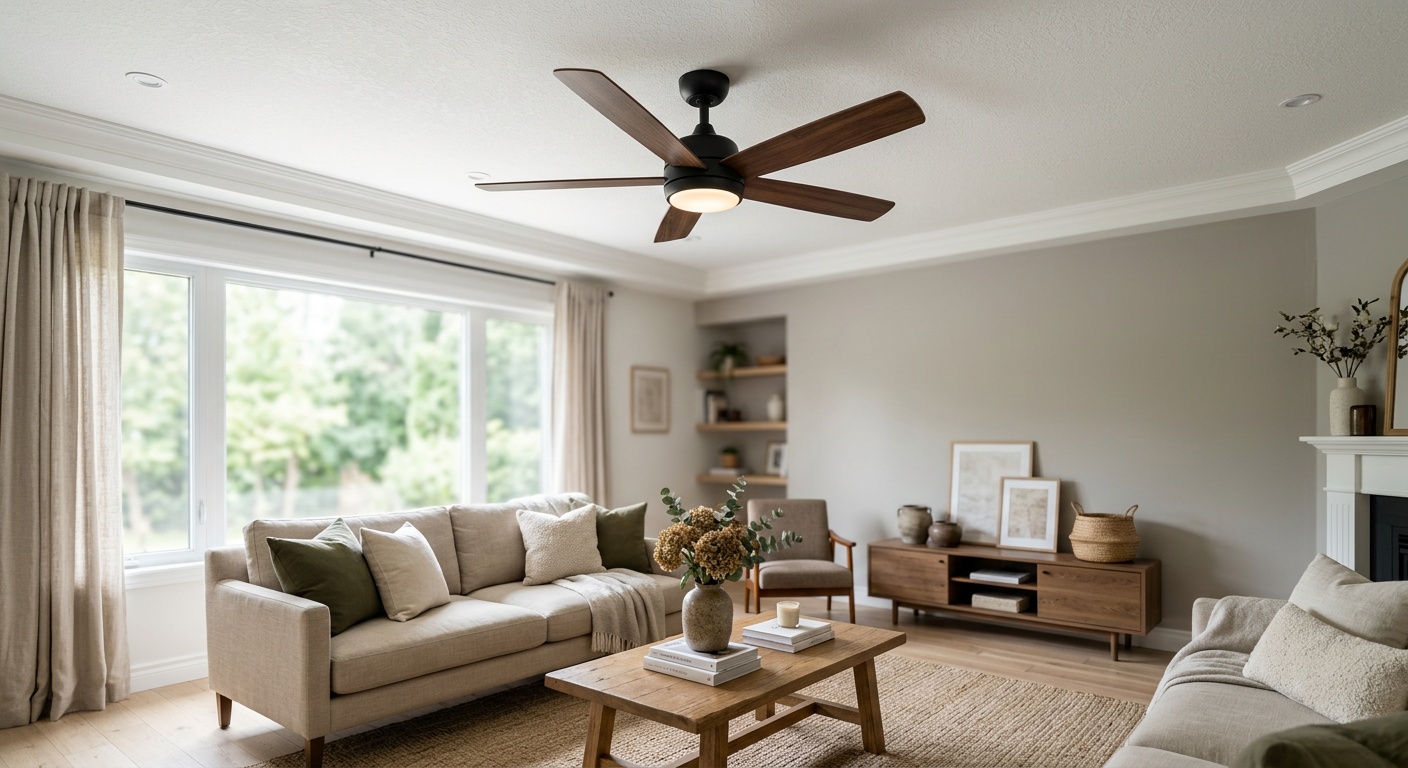
Best Ceiling Fan Styles for Open-Plan Villa Living Rooms
Reading time: 12 minutes
Picture this: you’ve just moved into a stunning open-plan villa, sunlight flooding through floor-to-ceiling windows, and a vast living space that feels both liberating and — let’s be honest — a little tricky to cool down. You’re standing in the center of that gorgeous room wondering: what kind of ceiling fan is actually going to work here?
You’re not alone. In 2026, open-plan villa living rooms have become one of the most sought-after residential design configurations globally, with a reported 63% increase in open-concept floor plan requests among luxury home buyers compared to 2021. But with that architectural freedom comes a practical challenge — air circulation across large, unobstructed spaces demands the right equipment, the right style, and the right placement strategy.
A ceiling fan in an open-plan villa isn’t just a functional appliance — it’s a design statement that anchors the space visually while doing serious aerodynamic work. Get it right, and your villa feels like a seamlessly curated retreat. Get it wrong, and you’ve got an undersized spinner struggling against 600 square feet of warm air.
This guide cuts through the noise. We’ll walk you through the best ceiling fan styles for open-plan villa living rooms, the technical specs that actually matter, and the design principles that ensure your choice elevates rather than disrupts your space.
Table of Contents
- Why Open-Plan Villas Demand a Different Approach
- The Top Ceiling Fan Styles for Large Open Living Spaces
- Technical Specifications That Actually Matter
- Common Challenges and How to Overcome Them
- Comparative Overview: Fan Styles at a Glance
- Frequently Asked Questions
- Choosing Your Fan: A Practical Action Plan
Why Open-Plan Villas Demand a Different Approach
Standard residential ceiling fans are designed for enclosed rooms — typically between 100 and 300 square feet with defined walls that help contain and redirect airflow. Open-plan villa living rooms operate on an entirely different scale. We’re talking spaces that regularly span 500 to 1,200 square feet, with soaring ceilings between 10 and 20 feet, multiple functional zones (dining, lounging, kitchen flow), and architectural features like exposed beams, double-height walls, or clerestory windows that create complex air movement patterns.
According to a 2025 report by the American Institute of Architects, approximately 71% of luxury residential builds completed in 2025 featured open or semi-open living configurations — a statistic that underscores just how mainstream this design philosophy has become. This shift means the ceiling fan industry has had to evolve rapidly, producing specialized models that address the unique demands of these environments.
The key insight here is this: in open-plan spaces, ceiling fans serve a dual purpose. They circulate air across extended horizontal distances, and they act as visual focal points that help define zones within an otherwise boundary-free room. A poorly chosen fan undermines both goals simultaneously.
The Airflow Challenge Unique to Open Plans
In an enclosed room, a fan creates a relatively predictable downdraft or updraft that bounces off walls and creates a circulatory loop. In an open-plan villa, there are no walls to bounce off. Airflow dissipates outward in all directions, reducing the perceived cooling effect significantly. This is why blade span, motor power (measured in CFM — cubic feet per minute), and blade pitch all carry far more weight in these environments.
The general rule of thumb that professionals use in 2026: for every 75 square feet of open-plan living space, you need a minimum of 1,000 CFM of airflow. A space of 600 square feet, therefore, ideally needs either one very powerful fan rated at 8,000+ CFM, or a strategically placed cluster of fans working in coordination.
The Aesthetic Responsibility of a Ceiling Fan in Villa Design
Interior designers consistently note that in open-plan spaces, ceiling-mounted elements carry disproportionate visual weight. Because there are fewer walls for art, shelving, or architectural detail, the eye naturally travels upward. A ceiling fan in a villa living room is therefore seen from multiple angles, from multiple zones, and under varying light conditions throughout the day.
This is why style selection isn’t merely a cosmetic consideration — it’s a structural design decision. The fan you choose communicates something about the entire room’s personality. Industrial-style fans signal raw, urbane confidence. Natural material fans (rattan, bamboo, woven blades) suggest organic luxury. Minimalist European designs imply refined restraint. Each choice sets a tone that ripples across every other design element in the space.
The Top Ceiling Fan Styles for Large Open Living Spaces
Let’s get into the styles themselves. These are the categories that interior designers and HVAC specialists most frequently recommend for open-plan villa living rooms in 2026, along with the specific contexts in which each style excels.
1. Large-Format Modern Minimalist Fans
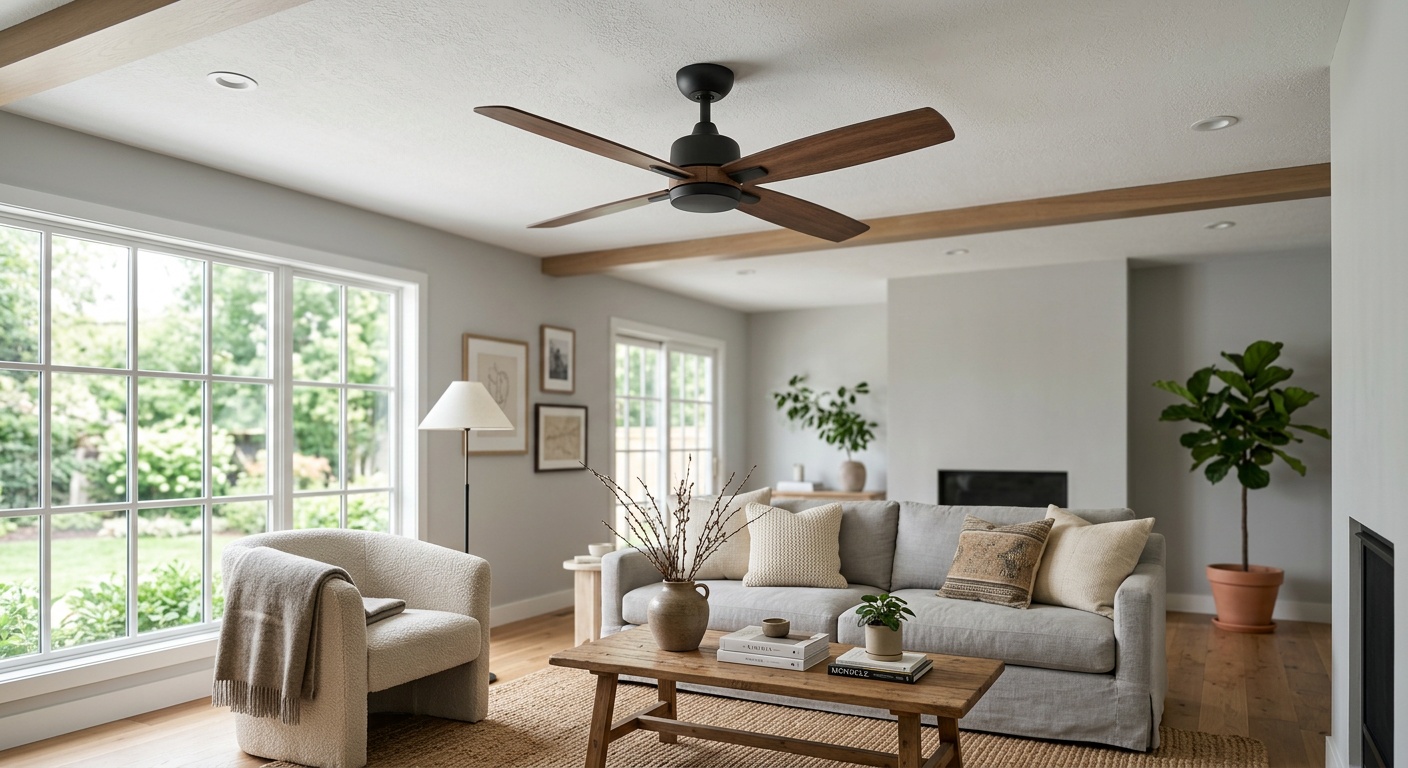
These fans are characterized by clean geometric lines, minimal visual clutter, and blade designs that integrate seamlessly with contemporary villa interiors. Think matte black or brushed nickel finishes, blades that appear almost impossibly thin, and motor housings that are compact yet powerful.
The Haiku Series by Big Ass Fans remains a benchmark in 2026, with their SenseME technology adjusting speed automatically based on occupancy and temperature. Their largest models push upward of 9,000 CFM with whisper-quiet operation — a crucial feature in open spaces where fan noise echoes rather than being absorbed by walls and soft furnishings.
Best for: Villas with contemporary or transitional interior design, white or neutral color palettes, and ceiling heights between 10 and 14 feet.
2. Industrial and Exposed-Element Fans
Industrial-style ceiling fans — featuring visible motor casings, metal blades, Edison bulb integrations, and raw material finishes like weathered bronze or oxidized iron — have surged in popularity for open-plan villa spaces that incorporate warehouse-conversion aesthetics or modern rustic design.
What makes them particularly effective in villas is their typically larger blade span (60 to 72 inches is common) and powerful motors. They’re also designed to handle higher ceilings well, with extended downrods available that bring the fan to an optimal operating height without looking awkward.
Case study: A Bali-based villa renovation completed in early 2025 replaced four undersized fans with two 72-inch industrial-style fans from Emerson Electric’s Pro Series. The result? A 40% reduction in air conditioning usage during peak daytime hours and overwhelmingly positive feedback from guests about the visual impact of the fans as design anchors in the combined living-dining space.
3. Natural Material and Organic Design Fans
Perhaps no style is more perfectly suited to the tropical or Mediterranean villa aesthetic than fans incorporating natural materials. Rattan, bamboo, woven palm, and reclaimed wood blades create a sense of textural warmth that synthetic materials simply cannot replicate.
In 2026, brands like Minka-Aire and Hunter have expanded their natural material lines significantly, responding to the growing demand from villa owners in Southeast Asia, the Caribbean, and Southern Europe. These fans typically feature five to seven blades with a wide pitch angle (12 to 15 degrees), which maximizes airflow while maintaining a sculptural aesthetic quality.
Best for: Beachfront villas, tropical retreats, farmhouse-influenced interiors, and any space where biophilic design principles are central to the overall vision.
4. Multi-Fan Cluster and Linear Configurations
One of the most architecturally sophisticated approaches for very large open-plan villas (800+ square feet) is the multi-fan configuration — either a cluster of three fans at varying heights or a linear series of fans positioned along the central axis of the space.
This approach has gained significant traction in 2025 and 2026 among luxury villa architects because it solves the CFM coverage problem while also creating a dramatic visual feature. When fans are identical in style and operate on a synchronized controller, the effect is both functionally superior and visually striking.
The practical requirement: all fans in a cluster configuration must be on a single-zone remote system or smart home integration to avoid competing airflow patterns that can create turbulence rather than smooth circulation.
5. Designer Sculptural and Statement Fans
For villas where interior design is operating at a truly elevated level, statement ceiling fans — those that blur the line between functional appliance and art installation — represent the pinnacle of the category. Brands like Moooi, Fanimation, and Monte Carlo Design have produced fans in 2025 and 2026 that could genuinely be described as kinetic sculpture.
These fans often feature unconventional blade shapes (curved, leaf-like, or asymmetrical), premium finishes (brushed gold, polished chrome, hand-painted surfaces), and integration with architectural lighting systems. They tend to be quieter (because they’re engineered to exacting tolerances) and come with sophisticated motor technology that maintains consistent RPM regardless of resistance.
Investment level: These fans typically range from $800 to $4,500 in 2026 pricing, but for a villa where every design decision is intentional, the investment is consistent with the overall vision.
Technical Specifications That Actually Matter
Beyond style, there are five technical dimensions that determine whether a fan will actually perform effectively in your open-plan villa. Many buyers — even experienced villa owners — get dazzled by aesthetics and underestimate the importance of these metrics.
Blade Span: Go Larger Than You Think
For open-plan living rooms, the minimum recommended blade span is 52 inches. For spaces over 400 square feet, 60 to 72 inches is standard. For truly grand spaces over 800 square feet, specialized large-format fans with spans up to 96 inches exist and are worth serious consideration.
Here’s the straight talk: most people undersize their fans by at least one blade-span category. If you’re thinking 52 inches, seriously consider 60. If you’re considering 60, look at 72. The difference in airflow is exponential, not linear.
Motor Quality and CFM Rating
CFM (cubic feet per minute) is the single most important performance metric. A premium villa fan should deliver a minimum of 6,000 CFM and ideally 8,000 to 12,000 CFM for large open spaces. DC motors, which have become the industry standard in premium fan segments by 2026, are significantly more efficient than AC motors — consuming up to 70% less energy while delivering superior airflow performance.
Mounting Height and Downrod Length
Ceiling fans perform optimally when the blades are positioned 8 to 9 feet above the floor. For villa ceilings at 12, 14, or 16 feet, this requires extended downrods — often 18 to 36 inches in length. Ensure your chosen fan is compatible with extended downrods, and that the downrod material and finish match the fan housing aesthetically.
Smart Home Integration
In 2026, smart integration is no longer a luxury feature — it’s a baseline expectation in villa design. Look for fans compatible with major platforms (Apple Home, Google Home, Amazon Alexa, and the increasingly adopted Matter protocol). The ability to schedule, automate based on temperature sensors, and adjust remotely transforms a ceiling fan from a passive appliance into an active climate management tool.
For those exploring complementary cooling strategies in specific zones, researching an alternative for ac can open up interesting possibilities for supplemental spot-cooling in home office areas or sleeping zones adjacent to your open-plan living space.
Noise Level
In an enclosed room, a slightly noisy fan is tolerable. In an open-plan villa, fan noise travels freely and can disrupt conversation, entertainment, or sleep in adjacent sleeping zones. Premium fans are rated at 35 to 45 dB at medium speed. Anything above 55 dB at medium speed is a dealbreaker for villa environments. Always check user reviews specifically for noise performance — manufacturer specifications can be optimistic.
Common Challenges and How to Overcome Them
Challenge 1: Inadequate Airflow Coverage Across Zones
The problem: A single fan, even a powerful one, often creates a cooling sweet spot directly beneath it while leaving peripheral zones (the dining area on the far end, the reading corner near the window) noticeably warmer.
The solution: Adopt a zoned fan strategy. Place your primary fan (the largest, most visually prominent) above the main seating area. Add a secondary fan — which can be smaller and less visually dominant — above the dining zone or kitchen-adjacent area. These secondary fans can be lower-profile models that don’t compete visually with the primary statement fan. Coordinate them on a single smart zone for synchronized operation.
Challenge 2: Fan Style Clashing with Villa Architecture
The problem: You fall in love with a fan online, install it, and realize it looks completely incongruous with your villa’s exposed concrete ceiling, or its brushed nickel finish fights with the warm timber tones of your interior.
The solution: Before purchasing, create a physical or digital mood board that includes your ceiling material, main interior finishes, dominant color palette, and existing light fixtures. The fan should either match one of these elements directly (finish coordination) or provide deliberate contrast that feels intentional (a matte black fan against a white vaulted ceiling). Never choose a fan in isolation from its context.
Case study: A client in a Tuscany-style villa in California made the mistake of installing a hyper-modern stainless steel fan in a space dominated by terracotta, warm wood, and arched doorways. The result was a jarring visual conflict that required a costly replacement with a wrought iron and dark-stained wood fan that harmonized with the Mediterranean aesthetic.
Challenge 3: High Ceilings Creating Installation Complexity
The problem: Villa ceilings at 15 feet or above require specialized mounting solutions, and standard fans simply can’t be installed effectively at that height without becoming visually detached from the inhabited space.
The solution: For ceilings between 12 and 16 feet, use extended downrods (18 to 36 inches) to bring the fan to optimal operating height. For ceilings above 16 feet, consider angled mounting kits (for sloped or cathedral ceilings) or consult with an electrician experienced in high-ceiling fan installations. Some premium brands offer custom downrod lengths specifically for architectural projects — Fanimation and Big Ass Fans both offer this service as of 2026.
Comparative Overview: Fan Styles at a Glance
The table below compares the five primary fan styles across the key decision metrics for open-plan villa living rooms:
| Fan Style | Typical CFM Range | Price Range (2026) | Best Ceiling Height | Design Compatibility |
|---|---|---|---|---|
| Modern Minimalist | 6,000–9,500 | $350–$1,200 | 10–14 ft | Contemporary, Transitional |
| Industrial | 7,000–11,000 | $280–$900 | 12–18 ft | Industrial, Modern Rustic |
| Natural Material | 5,500–8,000 | $200–$750 | 9–13 ft | Tropical, Coastal, Farmhouse |
| Multi-Fan Cluster | 15,000–30,000+ | $800–$3,500 (system) | 10–20 ft | All styles (matching set) |
| Sculptural Statement | 6,000–10,000 | $800–$4,500 | 11–16 ft | High-design, Eclectic, Luxury |
CFM Performance by Fan Style (Visual Comparison)
Practical Tips for Making Your Final Decision
Before you commit to a purchase, here’s a focused checklist of considerations that experienced villa owners and interior designers use to validate their final selection:
- Measure your exact ceiling height before selecting a fan model — this determines downrod requirements and rules out specific configurations entirely.
- Calculate your room’s square footage and multiply by the CFM-per-square-foot benchmark (minimum 13 CFM per square foot for open plans) to establish your minimum performance threshold.
- Pull finish samples from your dominant interior materials and compare them physically against fan finish samples or swatches — screen color representations are notoriously inaccurate.
- Verify motor type — insist on DC motor technology for any fan in a premium villa context. The energy efficiency and quiet operation advantages are non-negotiable at this level.
- Check smart home compatibility with your existing system before purchasing. Not all “smart” fans work with all platforms, and incompatibility discovered after installation is an expensive problem.
- Read professional installation requirements — large-format fans (60 inches and above) typically require specialized mounting hardware and may need structural reinforcement of the ceiling junction box.
Pro tip: If you’re torn between two options, choose the one with the better motor and CFM rating over the one with the better aesthetics. You can adapt stylistically with lighting choices, blade finish swaps, or even canopy replacements, but you cannot upgrade a weak motor after installation without replacing the entire unit.
Frequently Asked Questions
How many ceiling fans do I need for an open-plan villa living room of 700 square feet?
For a 700 square foot open-plan living room, the recommended approach in 2026 is either one very large, high-performance fan (72 inches or above) rated at 9,000+ CFM positioned above the primary seating zone, paired with a secondary fan above the dining or kitchen-adjacent area. Alternatively, a synchronized three-fan linear configuration across the length of the space provides exceptional even coverage. A single standard fan of 52 or 60 inches will be significantly undersized for this square footage and will create noticeable hot zones in peripheral areas.
What ceiling fan finish works best with open-plan villa interiors in 2026?
The most versatile and widely recommended finish for open-plan villa interiors in 2026 is matte black — it works with warm and cool color palettes, reads as intentional rather than accidental, and has enough visual weight to anchor large spaces without dominating them. Brushed nickel and champagne bronze are strong alternatives for spaces with metallic accent elements. For tropical or Mediterranean villa styles, dark oil-rubbed bronze or natural wood finishes remain the most architecturally sympathetic choices. The key principle: match at least one other metallic or material element already present in the space.
Can I use a ceiling fan as the primary cooling solution in a villa living room, or do I always need air conditioning?
This depends substantially on your villa’s climate zone and the season. In Mediterranean climates, well-chosen ceiling fans with high CFM ratings can serve as primary cooling during spring and autumn, and as effective supplements to air conditioning during peak summer — potentially reducing AC energy consumption by 30 to 40%. In tropical climates, ceiling fans alone are typically insufficient as primary cooling during peak heat months but dramatically enhance the perceived cooling effect of air conditioning when used in combination. Modern energy-efficient DC motor fans have made this hybrid approach increasingly cost-effective, and smart integration allows both systems to operate in coordinated response to real-time temperature readings.
Elevating Your Villa: The Action Plan Forward
Open-plan villa living rooms in 2026 represent one of the most exciting intersections of architecture, interior design, and climate comfort technology. The ceiling fan choices available today are genuinely remarkable — from sculptural statement pieces that double as kinetic art to industrial powerhouses that can shift thousands of cubic feet of air per minute in near-silence. The right choice transforms not just the climate of your space, but its entire experiential quality.
Here’s your practical roadmap for making the best decision:
- Assess and document your space — ceiling height, square footage, ceiling material, existing finishes, and smart home platform within the next week.
- Establish your minimum CFM requirement based on square footage, then identify three models that meet or exceed that threshold in your preferred style category.
- Request physical samples or showroom visits for your top two finalists — never make a final decision for a villa-scale purchase based on website photography alone.
- Consult a qualified electrician about mounting requirements before finalizing your choice — ceiling junction box capacity and structural reinforcement needs can affect which models are viable for your specific installation.
- Plan your installation as part of a broader lighting and climate refresh — a new ceiling fan is an ideal trigger moment to also upgrade to smart lighting and integrate a unified climate control scene.
As sustainable architecture and biophilic design continue reshaping luxury residential standards globally, the humble ceiling fan has emerged as a surprisingly sophisticated tool — one that bridges energy efficiency, aesthetic ambition, and genuine comfort. The trend toward smarter, quieter, more beautiful fans shows no signs of slowing, and villa owners who invest thoughtfully now will be ahead of the curve as these technologies continue evolving through 2027 and beyond.
So here’s the question that matters most: what does your open-plan villa feel like right now on a warm afternoon — and what could it feel like with the right fan turning overhead? The answer might be the most impactful interior upgrade you make this year.
Article reviewed by Rachel Wu, Budget Control & Project Timeline Management Consultant, on June 8, 2026